Disclosure: This post contains affiliate or referral links. We may earn a commission if you sign up for a tool through our links, at no cost to you. Promotional amounts, terms, and availability are set by each app and can change at any time. Always review and confirm the current offer before signing up. Terms apply. AI tools assisted in the research and drafting of this content; all opinions and recommendations are the author’s own.
Cornerstone Guide · Volume 2
AI search visibility is the first ranking game a solopreneur or small business can actually win. Search is quietly splitting in two. Half of your future customers still type a query into Google and scan a page of blue links. The other half now ask ChatGPT, Perplexity, Gemini, or Google’s own AI Overviews a question in plain English, read the answer they get back, and never see a list of links at all. If your business is not part of that answer, you are invisible to those buyers, no matter how polished your website is.
For years, ranking meant out-spending and out-linking bigger competitors. That was a fight a small business or a team of one was never going to win. AI search visibility changes the rules, and it changes them in your favor. This guide is the plain-English playbook for how a solopreneur or small business gets found, mentioned, and cited when customers ask AI instead of Googling. No agency, no backlink budget, and no marketing department required. Just the moves that actually move the needle, researched and evaluated so you can spend your limited hours only on the ones that count.
What AI Search Visibility Actually Is (and Why It Is Not Traditional Google Search)
AI search visibility is what happens when someone asks a question to a tool that answers in sentences instead of links. Rather than returning ten blue links for you to sift through, an answer engine like ChatGPT or Perplexity reads across the web, synthesizes what it finds, and hands back a single written response, often naming and linking a few sources it decided to trust. Google now does the same thing at the top of its results page with AI Overviews. The reader gets their answer without a single click, unless something in that answer earns the click.
Two clunky acronyms describe the work of showing up here. Answer Engine Optimization (AEO) is about being the source an answer engine pulls from. Generative Engine Optimization (GEO) is the same idea aimed at generative tools like ChatGPT. You do not need to memorize either term. What matters is the shift underneath them: the goal is no longer to rank a page at position one. The goal is to be one of the handful of businesses the model mentions when it composes its answer.
That difference is bigger than it sounds. Google rewards a single winner. One page sits at the top, collects most of the clicks, and everyone below fights for scraps. AI search visibility works more like a rotating shortlist. Ask the same question twice and you often get a slightly different set of names, because the model is assembling its answer fresh each time from whatever it considers relevant and trustworthy. There is no permanent number one to dislodge. There is a shortlist, and your job is to keep earning a spot on it.
| Traditional Google SEO | AI Search | |
|---|---|---|
| What you are competing for | A ranked position on a page of links | A mention inside a written answer |
| What wins | Backlinks, domain authority, on-page SEO | Being mentioned, quoted, and cited across the web |
| What the result looks like | Ten blue links; the user chooses | One synthesized answer naming a few sources |
| How stable it is | Rankings hold for weeks or months | A rotating shortlist that reshuffles per query |
| Who it favors | Established sites with big link budgets | Clear, credible, frequently-mentioned brands of any size |
Read that last row again, because it is the whole reason this guide exists. Traditional SEO quietly favors whoever has been around longest and spent the most. AI search does not care how old your domain is or how many links you have bought. It cares whether you are clear about what you do and whether credible places on the web back that up. For the first time, the deck is not stacked against a newcomer running a lean business, whether that is a solopreneur alone or a small team. That is the shift worth building around, and it is why AI search visibility is worth your time.
Why AI Search Visibility Is Good News for Solopreneurs and Small Businesses
Here is the part nobody selling you SEO wants to say out loud. The old game was rigged against you. Ranking on Google in a competitive niche meant accumulating backlinks, and backlinks are bought, earned over years, or manufactured by teams you cannot afford. A solopreneur or small business starting today was structurally behind on day one.
AI search visibility runs on a different fuel. When researchers looked at what actually predicts whether a brand shows up in AI answers, brand mentions across the web correlated roughly three times more strongly with AI visibility than backlinks did. In other words, the models care less about who links to you and more about who talks about you, names you, and describes what you do. That is a game a sharp solopreneur or small business can play without a budget, because being genuinely useful and being talked about does not require a marketing department.
The rotating shortlist helps you too. Because there is no fortress position one to storm, and because the lineup reshuffles constantly, the volatility that frustrates big brands is your opening. A well-described, credible small business can slip onto the shortlist for a specific, buyer-ready question far faster than it could ever have climbed to the top of Google for the same term. You are not trying to beat everyone. You are trying to be clearly the best answer to a narrow question, and to be mentioned enough that the model notices. That is the whole of AI search visibility in one sentence.
One caveat, because it cuts both ways. Mentions compound, and the gap between the mentioned and the ignored is wide. In one analysis, the top tier of brands by mention volume averaged roughly 169 AI answer appearances while the next tier down averaged about 14. That looks discouraging until you flip it: those leaders were not born on the shortlist, they earned their AI search visibility by being named steadily over time, and almost none of your direct competitors are doing this work yet. The advantage goes to whoever starts consistently first, and in most small niches that seat is still empty.
This is not a niche behavior you can wait out, either. McKinsey estimates that agentic commerce, where AI agents shop, compare, and transact on behalf of people, could drive substantial sales globally by 2030. The buyer asking an AI which tool, which service, or which provider to choose is not a curiosity. It is the front edge of how a large share of purchasing decisions will start. For a solopreneur or small business, earning AI search visibility is the cheapest customer acquisition you will ever set up.
How to Get Cited in AI Search Visibility
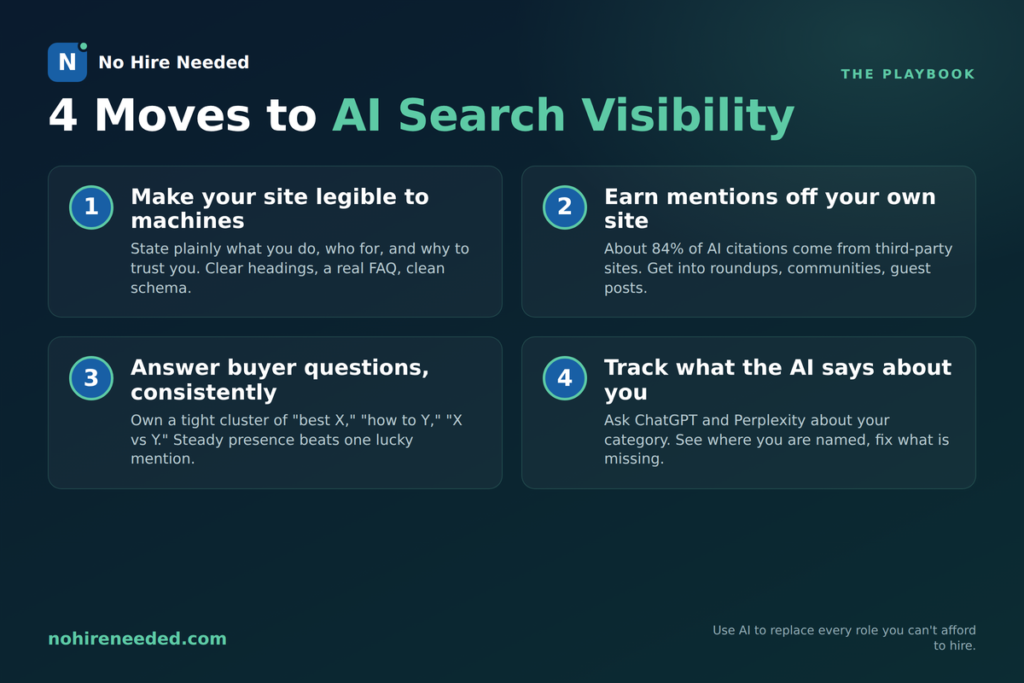
Winning AI search visibility comes down to four moves. None of them require a team, and all of them compound. Do them in order.
1. Make your site legible to the machines reading it
The foundation of AI search visibility is simple: before a model can recommend you, it has to understand you. That means your site should state, in plain words a machine can parse, exactly what you do, who you do it for, and why anyone should trust you. Not clever taglines. Clear claims. A one-line description of your offer near the top of your homepage. An about section that establishes credibility with specifics. Content organized under real headings, with a short frequently-asked-questions block that answers the exact questions buyers type.
Structure is doing real work here. Answer engines lean on clean formatting, direct question-and-answer phrasing, and structured data (schema) to decide what a page is about and whether to quote it. If you run on WordPress, an SEO plugin like Rank Math adds that schema and clean metadata for you, so machines get a tidy, structured version of every page without you writing a line of code. A page that buries its point under three paragraphs of throat-clearing gets skipped. A page that states the answer in the first sentence, then supports it, gets cited. If you want help shaping content this way, a tool like Frase researches the questions people actually ask around a topic and helps you structure the answer the way answer engines prefer, which is a real time-saver when you are the whole content team or a small one.
2. Earn mentions where the models actually read
This is the move that separates people who understand AI search visibility from people who are still just polishing their own homepage. Your website is not where the models do most of their reading about you. Recent analysis found that roughly 84% of the sources AI tools cite are third-party sites, not the brand’s own domain. The AI trusts what other places say about you far more than what you say about yourself.
So the work is to get mentioned off your own site, honestly and usefully. Get listed in the directories and roundups for your category. Answer real questions in the communities where your buyers hang out, without spamming links. Earn honest comparisons and reviews. Contribute a genuinely useful guest piece. Every place that names you and describes what you do is another vote for your AI search visibility, another data point telling the models you are a real, relevant option. You are not buying links. You are becoming a name that keeps coming up, which is exactly what the models are counting.
Make it concrete. Say you run a small bookkeeping service for creative freelancers. A directory listing in a “best bookkeepers for freelancers” roundup, one genuinely helpful answer in a freelancer subreddit about quarterly taxes, and a guest post on a small-business blog explaining a common mistake, together, do more for your AI search visibility than a month of tweaking your own homepage. Three honest mentions in the right places is a realistic week of work for a solopreneur or a small team, and it is exactly the trail of breadcrumbs the models follow back to you.
3. Answer the buyer-intent questions, consistently
The shortlist rotates, which means a single lucky mention does not hold. Presence does. The businesses that keep their AI search visibility are the ones that show up, again and again, as a credible answer to the specific questions their buyers ask. That means writing to the real questions, the “best tool for X,” the “how do I do Y as a small business,” the “X versus Y” comparisons, and covering them well enough and often enough that your name becomes a pattern the model recognizes.
For a solopreneur or small business, consistency is the whole strategy. You will not out-publish a content team. You do not have to. You have to own a tight cluster of buyer-ready questions completely, so that anyone, human or model, asking about your corner keeps landing on you. Depth on a narrow set beats thin coverage of everything, and it is how AI search visibility compounds over time.
4. Track what the AI actually says about you
You cannot improve what you never look at. The final move in building AI search visibility is to check, regularly, what the answer engines say when someone asks about your category. Are you named? Are you described accurately? Are you missing from questions you should own? This used to mean manually asking ChatGPT and Perplexity the same questions over and over. A visibility tracker like SE Ranking now monitors how and where you appear across AI results, so you can see which questions you already win, which ones you are close on, and where a competitor is getting named instead of you. If you want a tool pointed squarely at the answer engines, Rankscale is built specifically to track your AI search visibility. Either one turns guessing into a feedback loop, which is the whole point. For a step-by-step way to run that check yourself for free, and the tools that automate it, see our AI search visibility checker guide.
The AI Search Visibility Tools That Help, by Job
You do not need a stack of software to start, and you should not buy one before you have done the free work above. But when you are ready to move faster, here are the tools that cover each action in this guide to AI search visibility, one row per action, so you can pick up a tool only for the part you actually need help with.
| The action | Tool | What it does for a business of one |
|---|---|---|
| Structure your content so answer engines can read it | Frase | Researches the real questions around a topic and helps you build clear, well-structured answers |
| Add schema and clean metadata (on WordPress) | Rank Math | Marks up your pages so machines get a tidy, structured version, no code required |
| Draft content faster | Rytr or Writesonic | Both speed up first drafts so a one-person shop keeps a steady rhythm; Rytr is the lighter-weight budget pick |
| Optimize a page against what already ranks | Scalenut or Surfer | Scalenut builds and optimizes SEO content in one place; Surfer flags what to add versus the top results |
| Track your AI visibility | SE Ranking or Rankscale | SE Ranking covers AI answers alongside full search-rank tracking; Rankscale is purpose-built for AI answer visibility |
Which specific tool you pick matters less than doing the four moves. The tool makes the work faster; it does not replace it. If you are still assembling the wider toolkit, an AI tool guide for solopreneurs and small businesses keeps the current picks in one place, and the AI tech stack every small business needs shows where AI search visibility fits alongside everything else you are running.
What to Do This Week
You do not have to overhaul anything. Pick this list up in order and you will have made real progress on your AI search visibility by the weekend, without spending a dollar.
- Rewrite your homepage’s first line. State exactly what you do and who it is for, in one plain sentence a machine could quote.
- Add a short FAQ that answers the three questions your buyers actually type before choosing someone like you.
- Ask the answer engines about your category. Type your key buyer questions into ChatGPT and Perplexity and note whether you are named, and who is named instead.
- Claim two mentions off your own site. Get into one relevant directory or roundup, and answer one real question in a community where your buyers are, no link-spamming.
- Pick one buyer question to own. Write the clearest, most useful answer on the internet to a single question in your niche, and structure it with a direct answer up top.
- Set up one visibility check. Decide how you will track your AI search visibility, even if it is a recurring calendar reminder to re-ask the same five questions.
The Bottom Line
For most of the internet’s history, a solopreneur or small business could not out-rank the companies with budgets and teams. AI search visibility quietly handed you a version of the game where clarity, credibility, and being genuinely talked about beat raw spending power. That is the rare shift that favors the small and the sharp. Make your site legible, earn honest mentions where the models read, own a tight set of buyer questions, and watch what the AI says back. Do that consistently and your solopreneur or small business can be the answer, right at the moment a customer asks. That is what building AI search visibility really means, and the window to plant your flag is open right now.
Want the tool-by-tool detail? Start with our best AI SEO tools for solopreneurs, then browse the full AI tools guide to build the rest of your stack.
Sources
- Ahrefs, An Analysis of AI Overview Brand Visibility Factors (75,000 brands studied): brand mentions vs. backlinks correlation.
- McKinsey & Company, Are you, or your AI agent, shopping on Cyber Monday? Agentic commerce revenue forecast to 2030.
- Muck Rack, Generative Pulse: share of AI citations drawn from third-party sources.