
New to No Hire Needed or just feel you are on the wrong page? Click on Home at the top of the page to start your journey with us. Welcome aboard! And if you are looking for statistics, you are in the right spot. Enjoy the read.
Every week another AI tool promises to do the work of a whole department. For a one-person business or a small team, the real question is not whether the hype is real, it is whether the numbers add up. So we gathered the current AI tool statistics that actually matter to a solo operator: how many small businesses have adopted AI, how much time it saves, how fast the market is growing, and, in our own original analysis, what it really costs to cover eight core roles with AI tools instead of hiring for them.
Every figure below is dated and linked to its source. Our own calculation is laid out step by step, benefits included, so you can check the math. Use anything here, and a citation link back to this page is all we ask.
Use the table of contents below to jump straight to any section, from adoption and productivity numbers to our original cost analysis.
The Real Cost of Replacing a Hire with AI, by Role (No Hire Needed Original Analysis)
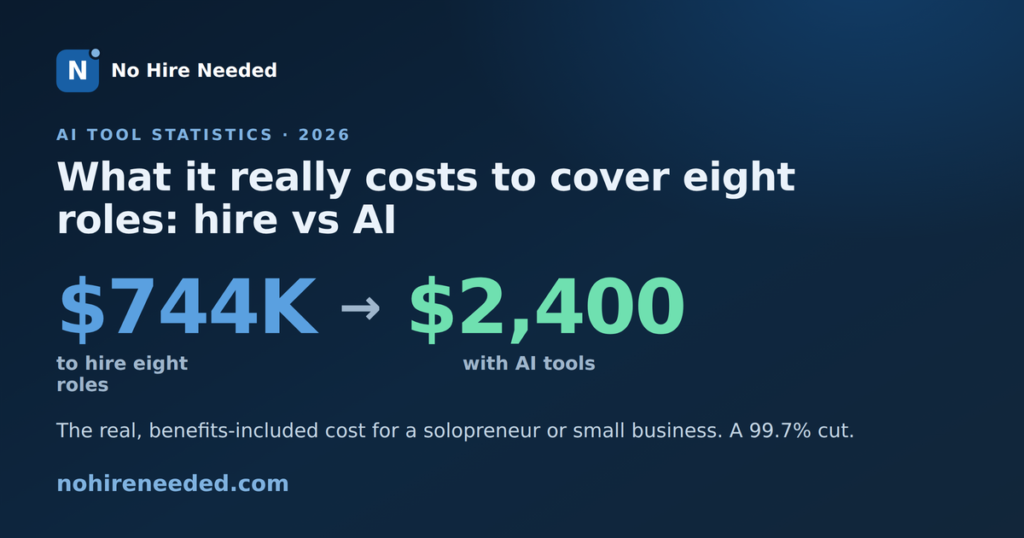
This is our own number, and it is the heart of the page. We took eight roles a growing business would normally hire for, took the current average U.S. salary for each, added the benefits and payroll costs an employer actually pays, and matched each role to the lead AI tool for its core work at its entry paid price. We researched and evaluated the pricing directly from each vendor in August 2026.
A salary is not the true cost of an employee. According to the U.S. Bureau of Labor Statistics, benefits make up 30.1% of total employer compensation costs, which means the real cost of a hire is roughly 1.43 times their base salary once health insurance, retirement, paid leave, and payroll taxes are counted. We built that into the numbers below.
How to cite this page
“No Hire Needed (2026) found that covering eight core business roles with AI tools costs about $2,400 a year, versus roughly $744,000 to employ people in those roles once benefits are included.”
Table 1 — What it really costs to employ each role (with benefits, 2026)
| Role | Base salary | Benefits & payroll (+43%) | True annual cost |
|---|---|---|---|
| Social media manager | $63,000 | $27,128 | $90,128 |
| Executive assistant | $70,000 | $30,142 | $100,142 |
| Graphic designer | $61,300 | $26,396 | $87,696 |
| SEO specialist | $86,511 | $37,252 | $123,763 |
| Content writer | $72,270 | $31,120 | $103,390 |
| Email marketing specialist | $74,831 | $32,222 | $107,053 |
| Bookkeeper | $49,210 | $21,200 | $70,410 |
| Customer support rep | $42,830 | $18,443 | $61,273 |
| Total | ~$519,952 | ~$223,903 | ~$743,855 |
That is the number an employer actually carries, not the salary alone. Now set it against the cost of covering the same work with AI tools.
Table 2 — Cost to cover each role with AI vs. hiring
| Role | True cost to hire | Lead AI tool for the core work | AI cost / year | Savings |
|---|---|---|---|---|
| Social media manager | $90,128 | Buffer | $60 | 99.9% |
| Executive assistant | $100,142 | Fyxer | $360 | 99.6% |
| Graphic designer | $87,696 | Canva Pro | $180 | 99.8% |
| SEO specialist | $123,763 | Morningscore | $828 | 99.3% |
| Content writer | $103,390 | Rytr | $90 | 99.9% |
| Email marketing specialist | $107,053 | MailerLite | $144 | 99.9% |
| Bookkeeper | $70,410 | QuickBooks Solopreneur | $240 | 99.7% |
| Customer support rep | $61,273 | Chatbase | $480 | 99.2% |
| Total | ~$743,855 | — | ~$2,382 | ~99.7% |
How we got there (methodology). Base salaries are current U.S. averages from the Bureau of Labor Statistics and Glassdoor. The true-cost column adds a 1.43x load for benefits and payroll taxes, based on the BLS finding that benefits are 30.1% of total compensation (March 2026). AI costs are each tool’s cheapest ongoing paid plan, verified on the vendor’s own pricing page in August 2026, then annualized. We used one lead tool per role for a clean comparison. In practice a solo operator often combines a few tools, which would raise the AI total modestly but not change the order of magnitude.
How to read the tool column. Each role shows the lead AI tool for its core, repeatable work, not a single tool that does the entire job. A tool automates and assists the parts of a role that repeat, while judgment, strategy, and relationships still take a person. So this compares what the tools cost against what the hires cost, not a claim that a subscription equals a skilled employee. The point is simpler and still striking: the work that used to require a payroll line now starts at the price of a few subscriptions.
Why marketing manager is not in the table. We left marketing manager out on purpose. No Hire Needed treats it as more of a department than a single role, and the specialist roles that make up that department, social media, email marketing, content, and SEO, are already on their own lines above. Adding a marketing manager on top would just double-count work the table already covers. On top of that, most solo and small businesses are not staffing a whole marketing function anyway. They reach for the one or two specialist tools they actually need right now. You can read more about how we break work into roles instead of departments in our AI Tools Guide, and more specifically in the hot sheet AI Marketing Tool for Solopreneurs and Small Business: Where to Start.
For context on that benefits load: the average private-sector employee costs an employer about $46.60 an hour in total compensation, roughly $97,000 a year for a full-time role, once benefits are included (BLS, March 2026). Wages are only about 70% of that bill.
AI Tool Statistics: Small Business and Solopreneur Adoption
Small-business AI adoption has moved from novelty to normal in about two years.
- Roughly 60% of small businesses used AI in their operations in 2025, up from 40% in 2024 and 23% in 2023. Adoption more than doubled in two years. (Source: U.S. Chamber of Commerce, 2025.)
- 58% of small businesses say they use generative AI. (Source: U.S. Chamber of Commerce, 2025.)
- About 40% of small businesses were using or planning to use AI in 2024, the first year the Federal Reserve asked. (Source: Federal Reserve 2024 Small Business Credit Survey.)
- 75% of small and midsize businesses are experimenting with or using AI, and 91% of those using it say it boosts revenue. (Source: Salesforce Small & Medium Business Trends, 2024.)
- 82% of small businesses say adopting AI is essential to stay competitive, though only about 25% have fully integrated it into daily operations. (Source: Reimagine Main Street with PayPal, 2025.)
- 65% of organizations regularly use generative AI, and 72% use AI in at least one business function, most commonly in marketing and sales. (Source: McKinsey, The State of AI in Early 2024.)
- 17% to 20% of all U.S. businesses reported using AI to produce goods or services in 2026, far higher at large firms (37% of those with 250 or more employees) than at the smallest ones. (Source: U.S. Census Bureau Business Trends and Outlook Survey, 2026.)
That last gap is the opening for a small operator. The tools that large companies use to pull ahead are available to a one-person business for the price of a subscription.
The Solo Economy by the Numbers
The audience for AI-as-a-team is enormous and growing.
- There are 29.8 million nonemployer businesses in the U.S., businesses with no paid employees, about 78% of all U.S. businesses. (Source: U.S. Census Bureau Nonemployer Statistics.)
- Solo businesses generated about $1.7 trillion, roughly 6.8% of the U.S. economy. (Source: U.S. Census Bureau.)
- 117,060 one-person businesses passed $1 million in revenue in 2023, and the count keeps rising year over year. (Source: U.S. Census Bureau, reported by Forbes, 2025.)
- 64 million Americans freelanced in 2023, about 38% of the workforce, contributing roughly $1.27 trillion to the economy. (Source: Upwork, Freelance Forward 2023.)
- Freelancers use generative AI at more than twice the rate of other professionals, 20% regularly versus 9%. (Source: Upwork, 2023.)
AI Productivity and Time-Saved Statistics
The productivity research is where the case for AI stops being a slogan and starts being measurable.
- Workers who used generative AI saved about 5.4% of their work hours, roughly 2.2 hours in a 40-hour week. (Source: Federal Reserve Bank of St. Louis, 2024.)
- 90% of AI users say it saves them time, and heavy users save 30 or more minutes a day. 75% of global knowledge workers now use generative AI at work, and 78% bring their own tools. (Source: Microsoft and LinkedIn 2024 Work Trend Index.)
- In a controlled study, professionals completed business writing 40% faster and at 18% higher quality using ChatGPT. (Source: Noy and Zhang, MIT, in Science, 2023.)
- Customer support agents using an AI assistant handled 14% more issues per hour, and the least experienced agents gained 34%. (Source: Brynjolfsson, Li and Raymond, NBER, 2023.)
- Developers finished a coding task 55% faster using an AI assistant. (Source: GitHub, 2022 to 2023.)
- Across three controlled studies, AI tools produced an average 66% increase in throughput. (Source: Nielsen Norman Group, 2023.)
- Marketers save an estimated 1 to 2 hours a day using generative AI, and 79% say it lets them spend less time on manual tasks. (Source: HubSpot AI Trends for Marketers, 2025.)
- About 1 hour of daily work is automatable with today’s technology, rising toward 3 hours a day by 2030. (Source: McKinsey, AI in the Workplace 2025.)
AI Tool Market Growth Statistics
The money flowing into AI tools tells you this is a durable shift, not a fad.
- The generative AI market is projected to grow from $22.2 billion in 2025 to $324.7 billion by 2033, a 40.8% annual growth rate. (Source: Grand View Research, 2025.)
- The total AI market is projected to reach $1.81 trillion by 2030. (Source: Grand View Research, 2025.)
- The AI agents market is projected to reach $50.3 billion by 2030, growing 45.8% a year, one of the fastest-growing categories. (Source: Grand View Research, 2025.)
- The AI writing assistant software market is projected to grow from $91.3 billion in 2025 to $988.5 billion by 2035. (Source: Precedence Research, 2025.)
- The AI in marketing market is projected to reach $82.2 billion by 2030. (Source: Grand View Research, 2024.)
- The AI in CRM market is projected to grow from $4.1 billion in 2023 to $48.4 billion by 2033. (Source: Market.us, 2024.)
- The AI for customer service market is projected to grow from $12.1 billion in 2024 to $47.8 billion by 2030. (Source: MarketsandMarkets, 2024.)
- The generative AI in design market is projected to grow from about $1 billion in 2025 to $16.9 billion by 2035. (Source: Precedence Research, 2025.)
What These AI Tool Statistics Mean for a One-Person Business
Read together, the numbers point one way. Adoption is mainstream and still climbing, the time savings are real and measured, and the tools that automate a role now cost a rounding error next to a salary with benefits. The old constraint on a small business was headcount: you could only do as much as you could afford to hire. That constraint is loosening. A solo operator with the right stack can now cover marketing, design, writing, SEO, bookkeeping, email, and support at a total tool cost that would not cover a single month of one employee’s fully-loaded pay.
None of this means the human disappears. Someone still has to decide, judge, and build the relationships. But the leverage a small business can now put behind one person is unlike anything the numbers showed even three years ago.
It helps to flip the comparison around. You do not have to imagine hiring all eight people for the gap to be staggering. A single marketing hire at a typical salary runs roughly $120,000 a year once benefits are loaded in, and that one paycheck alone is about fifty times the cost of every AI tool on this page combined. Whether a small business would realistically staff one role or eight, the same conclusion holds: the fully-loaded cost of even a single employee dwarfs an entire year of software.
Put in monthly terms, the whole stack in our analysis runs about $200 a month. That is less than many owners spend on coffee and parking, and it covers social scheduling, an inbox assistant, design, SEO, writing, email marketing, bookkeeping, and a support chatbot. A solopreneur does not need every tool at once, either. Most start with the one or two that relieve their sharpest pain, add another when it pays for itself, and let the stack grow only as fast as the work demands. The numbers scale down just as easily as they scale up.
Read the savings as leverage, not as a payroll you avoided. Most solo operators were never going to hire eight people, so the real story in these AI tool statistics is not the money saved, it is the work unlocked. A professional function that used to sit behind a salary is now within reach of anyone willing to learn a tool. The barrier to covering marketing, design, or bookkeeping has fallen from a hiring decision to a subscription, and for a one-person business or a small team, that quietly changes what is possible in a single week.
Frequently Asked Questions
How much can AI tools save a small business versus hiring?
In our 2026 analysis, covering eight core roles with AI tools costs about $2,400 a year, compared with roughly $744,000 to employ people in those roles once benefits are included. That is a cost comparison of tools versus fully-loaded pay, not a claim that AI fully replaces a skilled employee.
What is the true cost of an employee beyond salary?
Benefits make up about 30% of total employer compensation, so the real cost of an employee is roughly 1.43 times their base salary once health insurance, retirement, paid leave, and payroll taxes are added. (Source: BLS, March 2026.)
What percentage of small businesses use AI?
About 60% of small businesses reported using AI in their operations in 2025, up from 23% in 2023, according to the U.S. Chamber of Commerce.
How much time does AI actually save?
Studies put it between roughly 5% of work hours saved across all users (Federal Reserve Bank of St. Louis) and 1 to 2 hours a day for marketers (HubSpot), with larger gains in controlled tasks like writing, coding, and customer support.
Which AI tools replace which roles?
No tool fully replaces a person, but common pairings include social scheduling tools for a social media manager, AI writing tools for a content writer, AI design tools for a graphic designer, and AI chatbots for front-line customer support. Our Tool Guide breaks these down by role.
Are these AI tool statistics current?
Yes. Every figure is dated to its source, most from 2024 to 2026, and we refresh this page at least once a year. Pricing in our original analysis was verified directly from each vendor in August 2026.
No Hire Needed researches and evaluates AI tools for solopreneurs and small businesses. Data on this page is compiled from the cited public sources and our own pricing research. Figures are accurate as of the last updated date and may change; verify current pricing with each vendor.